
The Problem with Compliance Reviews
Most compliance reviews start too late. By the time someone asks privacy, security, or legal to look at the system, the architecture is already baked, the data paths are already messy, and the fixes are already expensive.
Today, that changes.
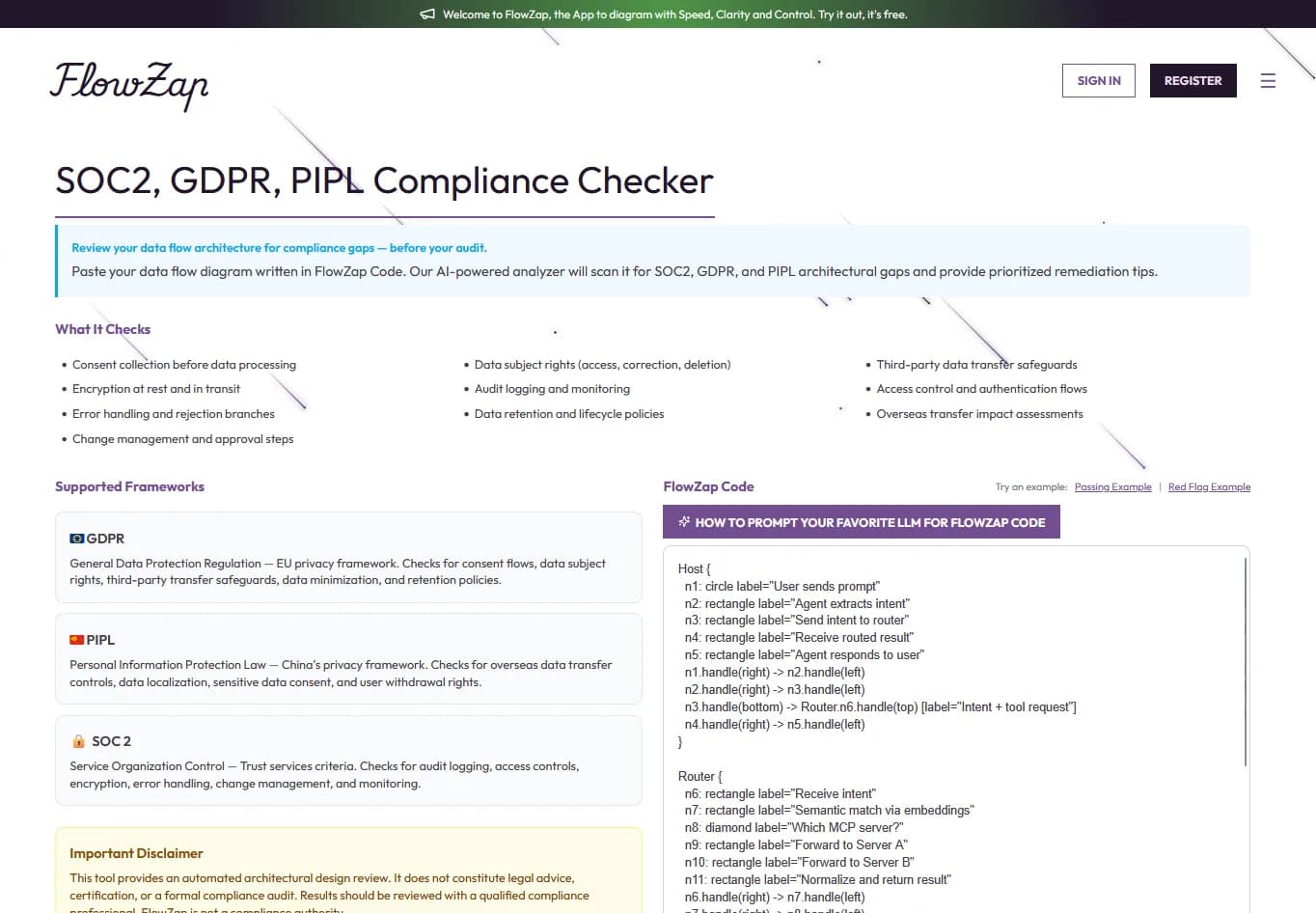
FlowZap now lets you paste a data flow written in FlowZap Code and get an instant architectural review for SOC 2, GDPR, and PIPL gaps before the audit starts. The checker is built to scan your flow for issues such as consent before processing, encryption coverage, data subject rights handling, audit logging, access control, retention policies, third-party transfer safeguards, and overseas transfer controls.
Your Diagram is Now Reviewable
FlowZap Code is already the structured backbone behind FlowZap's workflow, sequence, and architecture views, which means the compliance checker is not guessing from a paragraph of prose. It is reading a defined system model made of lanes, nodes, edges, decisions, and loops, then pointing to where the design itself needs work.
That is the real shift here.
Instead of filling out a generic questionnaire, you can submit the actual data flow architecture and get feedback tied to the exact places where risk appears. In the results shown on the page, the checker does not stop at broad warnings; it recommends concrete edits such as inserting a consent gate before processing, adding audit logging after major nodes, labeling transfer edges, adding breach-handling branches, and enforcing localization or processor checks where the flow crosses systems.
Built for Real Remediation
The output is organized by framework, so teams can see GDPR, PIPL, and SOC 2 findings separately instead of trying to untangle one giant blob of compliance noise. In the examples displayed, GDPR findings include consent before collection, legal basis, transfer safeguards, data subject rights, retention, breach notification, and data minimization; PIPL findings include separate consent for sensitive data, overseas transfer controls, data localization, transfer impact assessment, withdrawal rights, and processor obligations; SOC 2 findings include audit logging, access control, encryption, monitoring, incident response, error handling, and availability controls.
That matters because remediation becomes architectural, not theoretical.
When a tool tells you "improve compliance," it creates work. When a tool tells you "add an auth gate here," "insert a logging step here," or "route deletion requests into a dedicated handling flow," it creates momentum. The screenshots show exactly that style of output: specific gaps, mapped to specific controls, with specific recommended changes to the model.
Privacy by Design, Not by Slogan
The page also makes an important trust promise: FlowZap says it does not store, retain, or log the FlowZap Code submitted for analysis, and that the data flow is processed and immediately discarded. It also clearly states that the checker is an automated architectural design review, not legal advice, certification, or a formal compliance audit.
That framing is smart.
It keeps the promise sharp: this is a fast, practical system-design review for builders who want to find issues early. It is not pretending to replace counsel, auditors, or a full compliance program.
Why This Matters Now
AI systems, MCP servers, routers, embeddings, tool calls, and cross-service orchestrations are creating more hidden data flows than most teams can reason about in their heads. FlowZap already positions itself around turning plain text into multi-view system diagrams, keeping one codebase as the source of truth, and exporting structured logic into operational workflows.
The new compliance checker extends that philosophy into governance.
If your architecture can be written as code, it can be inspected as code. If it can be inspected early, it can be improved before audit prep turns into cleanup. And if compliance feedback is attached directly to the diagram, teams stop treating privacy and security as after-the-fact documentation and start treating them as part of system design.
Paste the Flow. Find the Gaps. Fix the Design.
This launch is exciting because it turns compliance into something builders can actually use at design time. Paste the flow, run the review, see the gaps, and upgrade the architecture before those gaps become incidents, audit findings, or expensive rewrites.
FlowZap has been pushing a clear idea from the start: stop dragging arrows and engineer systems instead. With the SOC 2, GDPR, and PIPL Compliance Checker, that same idea now applies to trust, privacy, and control too.
It's fast. No long questionnaire, just use your FlowZap MCP to generate your real current data flow.
Want to have a quick try? Copy the following Account Deletion Workflow:
User { # User
  n1: circle label="Start"
  n2: rectangle label="Request account deletion"
  n3: rectangle label="Confirm via email link"
  n4: rectangle label="Download data export"
  n5: rectangle label="Receive deletion confirmation"
  n6: circle label="End"
  n1.handle(right) -> n2.handle(left)
  n2.handle(bottom) -> App.n7.handle(top) [label="Submit request"]
  n3.handle(bottom) -> App.n10.handle(top) [label="Confirmed"]
  n4.handle(right) -> n5.handle(left)
  n5.handle(right) -> n6.handle(left)
}
App { # Application
  n7: rectangle label="Validate user identity"
  n8: diamond label="Active subscriptions?"
  n9: rectangle label="Send confirmation email"
  n10: rectangle label="Queue deletion job"
  n11: rectangle label="Generate data export"
  n7.handle(right) -> n8.handle(left)
  n8.handle(right) -> n9.handle(left) [label="No"]
  n8.handle(bottom) -> Billing.n15.handle(top) [label="Yes - Cancel first"]
  n9.handle(top) -> User.n3.handle(bottom) [label="Email sent"]
  n10.handle(bottom) -> Backend.n12.handle(top) [label="Process"]
  n11.handle(top) -> User.n4.handle(bottom) [label="Ready"]
}
Backend { # Backend
  n12: rectangle label="Anonymize user records"
  n13: rectangle label="Delete personal data"
  n14: rectangle label="Purge from backups"
  n12.handle(right) -> n13.handle(left)
  n13.handle(right) -> n14.handle(left)
  n14.handle(top) -> App.n11.handle(bottom) [label="Complete"]
}
Billing { # Billing
  n15: rectangle label="Cancel active subscriptions"
  n16: rectangle label="Process final invoice"
  n15.handle(right) -> n16.handle(left)
  n16.handle(top) -> App.n9.handle(bottom) [label="Cleared"]
}
and paste it into the compliance checker.