

The 47-Step Nightmare
There are numerous hidden steps involved in a UCP e-commerce flow. In a classic storefront, the user clicks buttons and the browser shows you what happened. In the UCP world, a shopper's intent is interpreted by an AI assistant and routed through a commerce gateway into catalog, checkout, and payment systems—often without any UI to "show the truth" when something breaks. That's why teams lean on interaction modeling (sequence diagrams) to make API-driven behavior understandable and reviewable before implementation.
Agentic commerce feels "simple" in demos, but in production it becomes an invisible, multi-system conversation that's hard to reason about and even harder to debug. The fix is to treat the Universal Commerce Protocol (UCP) like a distributed system and map the handshake end-to-end before coding.
Know What UCP Already Provides
UCP is designed around discovery + negotiation between an agent and a merchant, rather than every developer inventing one-off integrations. It defines "core capabilities" (like Checkout, Discovery, Fulfillment) so commerce can be composed in layers instead of becoming a brittle monolith.
UCP also models checkout as a state machine. The protocol explicitly handles states like incomplete, requires_escalation, and ready_for_complete. When the agent can't proceed autonomously (e.g., missing shipping info), the merchant server responds with a structured continue_url. This allows the agent to hand off the user to a secure web view to complete the task, then resume the conversation via an embedded protocol channel (JSON-RPC 2.0).
In plain English: UCP gives you the primitives (negotiation, states, escape hatches). Your job is orchestration, UX, and reliability.
What the Developer Actually Builds (the "Glue Code")
While UCP is handling the backend, you still have to build the agent's brain. Your code owns the decisioning (forming queries, ranking results), the state handling (reacting to incomplete signals), and the trust layer (collecting explicit payment confirmation).
In our architectural analysis, the biggest risks show up exactly where the flow pauses or branches:
- The "Hallucination" Gap: What if the catalog returns zero results?
- The "Missing Data" Loop: What if the user didn't provide a zip code?
- The "Silent Auth" Risk: Did the user actually say "pay now"?
These aren't Shopify problems; they are orchestration problems. And they are why a visual map is critical.
The 47 Interactions: Who Owns What?
We broke down the standard 47-step purchase flow to show exactly where your responsibility begins and ends.
| Phase | Steps | Mostly handled by UCP / Merchant | Mostly handled by Developer (Agent Side) |
|---|---|---|---|
| Intent → Structured Search | 1–6 | None. This is upstream user intent intake. | Turn messy intent into a stable Catalog Query. Log assumptions. Avoid hallucinating constraints. |
| Catalog Query → Products | 7–11 | The Gateway responds with matching products (or empty sets). | Choose a query strategy. Handle zero-result states gracefully (e.g., "Clarify and Retry" loop). |
| Selection → Checkout Session | 12–20 | UCP creates the session ID and defines the checkout state machine. | Persist the session_id. Prepare to handle state changes (not just "success/fail"). |
| Required Fields Loop | 21–30 | UCP signals incomplete or requires_escalation. |
Prompt the user for missing fields. Submit updates idempotently. Re-request totals. |
| Payment Confirmation | 31–38 | Payment collection is delegated to handlers (e.g., Shop Pay or any payment handlers). | Enforce an explicit confirmation gate. Do not capture funds without a user signal. |
| Order Status → Notify | 39–47 | The Store is authoritative for status and fulfillment updates. | Map status codes to your UI. Implement correlation IDs for support tracing. |
Why FlowZap is the Right Format for This
Documentation rots. Static diagrams are ignored.
FlowZap solves this with Sequence Diagram Mode. You define the logic once in code—mapping the exact handoffs between your Agent and the UCP Gateway—and we render two views automatically:
- The Architect's View (Sequence): Precise API calls, strict typing of participants (
Shopper,Assistant,Gateway), and visualization of loops and wait states. - The Stakeholder's View (Flow): A simplified journey map that explains what is happening without the protocol noise.
This ensures your PM, your Lead Dev, and your QA team are all looking at the same source of truth.
Don't Start from Scratch. Use the Template.
We know you don't want to spend your sprint mapping out 47 interaction steps. So we did the heavy lifting for you.
We have released the Shopify UCP Blueprint as a free template in the FlowZap library. It comes pre-loaded with:
- The Full Logic: All 47 steps from the standard purchase flow, scripted in editable FlowZap code.
- Annotated Ownership: We've tagged steps as
// UCP Managedvs// Dev Requiredso you can instantly see your implementation surface area. - Critical States: Pre-built loops for
missing_infoandpayment_confirmationready for your specific logic.
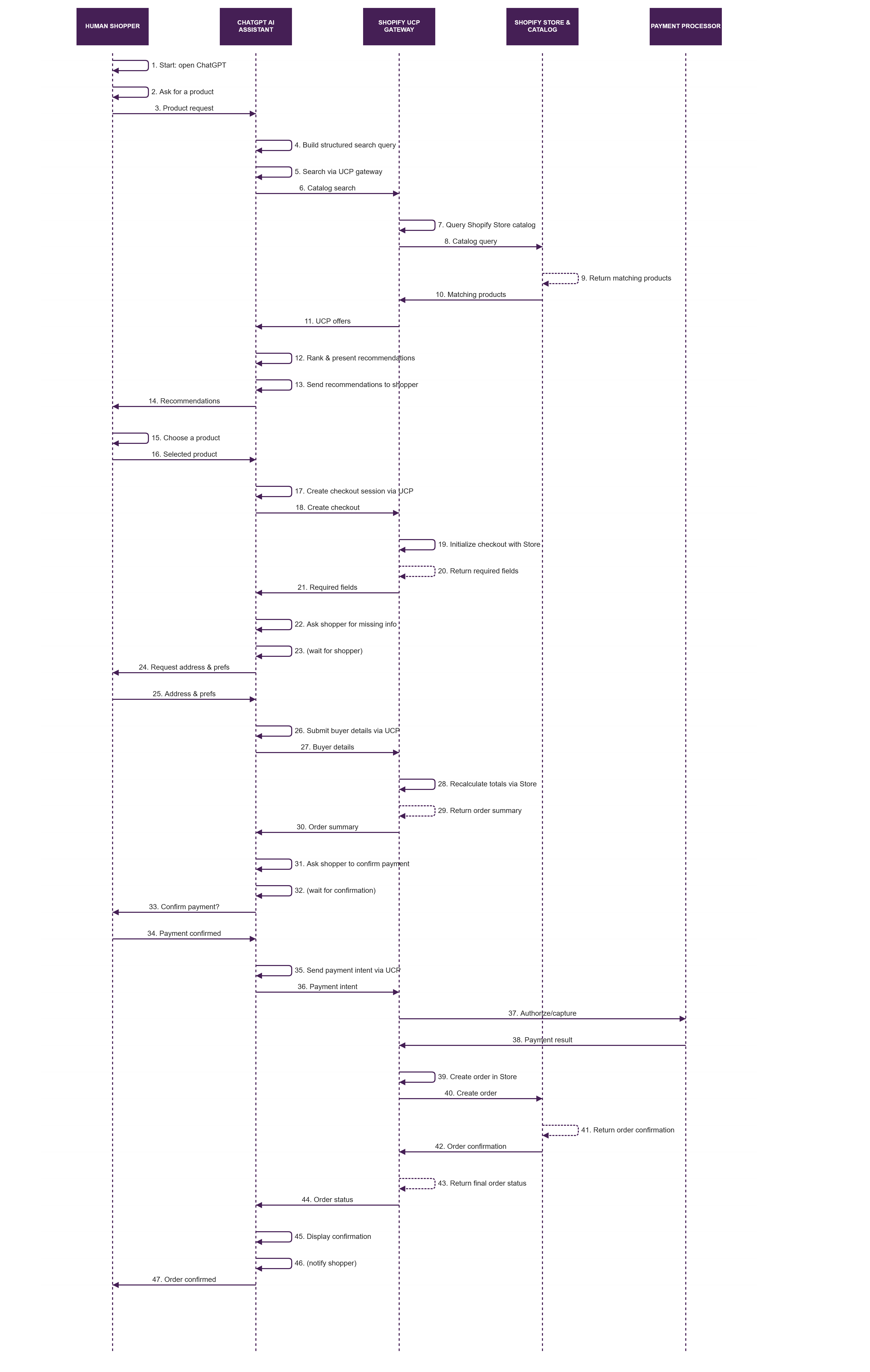
The Three "Kill Zones" (Where Integrations Usually Fail)
The diagram is long, but the failure modes cluster in predictable places: translation, data collection, and payment trust. Below are the three zones worth over-documenting (and over-testing) because they create the most expensive bugs.
Kill Zone 1: The "Hallucination Gap" (Steps 4–10)
The AI assistant must transform a vague request into a structured query, then the gateway queries the store catalog and returns matching products. If the catalog returns "nothing relevant," the worst possible behavior is the assistant confidently "making up" an option; the correct behavior is to branch into clarification ("color?", "budget?", "brand?") and retry with tighter constraints.
FlowZap helps here because you can model the retry as a first-class loop, instead of burying it in ad-hoc prompt logic. FlowZap Code even supports a loop fragment syntax designed to express retry logic compactly, which is exactly what "clarify and retry" is.
Kill Zone 2: The "Missing Data Loop" (Steps 21–30)
After checkout initialization, the store returns required fields (shipping address, shipping option, email, etc.), and the assistant must pause the protocol to ask the shopper for missing data. This is where many agentic flows die in production: a missing-field response is not an "error," it's a state transition that requires a user prompt and a wait state.
The diagram explicitly shows "ask shopper for missing info," "wait," and then "submit buyer details," followed by "recalculate totals" and "return order summary." That's not fluff—those steps are your blueprint for idempotency and for preventing duplicate submissions when a user changes their mind mid-checkout.
Kill Zone 3: The "Silent Payment" Risk (Steps 31–38)
The diagram makes payment confirmation an explicit handshake: show an order summary, ask for confirmation, wait, then send a payment intent and proceed to authorize/capture. That separation is a safety rail: it forces a clear boundary between "recommendation/conversation" and "money movement."
For developers, this is where sequence diagrams earn their keep: it becomes obvious which actor is responsible for each action and exactly when the payment processor is invoked. It also becomes obvious where to attach audit logs (what was shown in the summary, what was confirmed, and when the intent was created).
The Bottom Line
Agentic commerce is not just about connecting an LLM to an API; it is about managing a complex, asynchronous conversation between a user, a bot, and a rigid banking protocol. The difference between a "demo" and a "product" is how gracefully your system handles the messy middle—the retries, the missing addresses, and the payment confirmations.
Stop guessing at the state machine. Fork our blueprint, map your specific edge cases, and give your team the visibility they need to ship with confidence.
Inspirations
- Google Developers Blog: Under the Hood - Universal Commerce Protocol
- Revize: UCP Shopify Developer Guide
- Shopify Engineering: UCP
- FlowZap: Alternatives to MermaidJS and PlantUML
- Shopify Dev: Agents Documentation
- Shopify Dev: Documentation
- Shopify News: Winter '26 Edition - Agentic Storefronts
- Shopify: Agentic Plan
- Tadpull: Shopify Agentic Commerce Guide
- Shopify Dev: Agents Checkout
- Ampifire: Agentic Commerce Protocol Setup Guide
- Presta: Implement UCP on Shopify
- Agentic Commerce Solutions
- YouTube: UCP Overview
- Presta: Complete 2026 Developer Guide
- Eesel AI: Agentic Protocol Shopify Integration
- Zenn: Storehero Article