
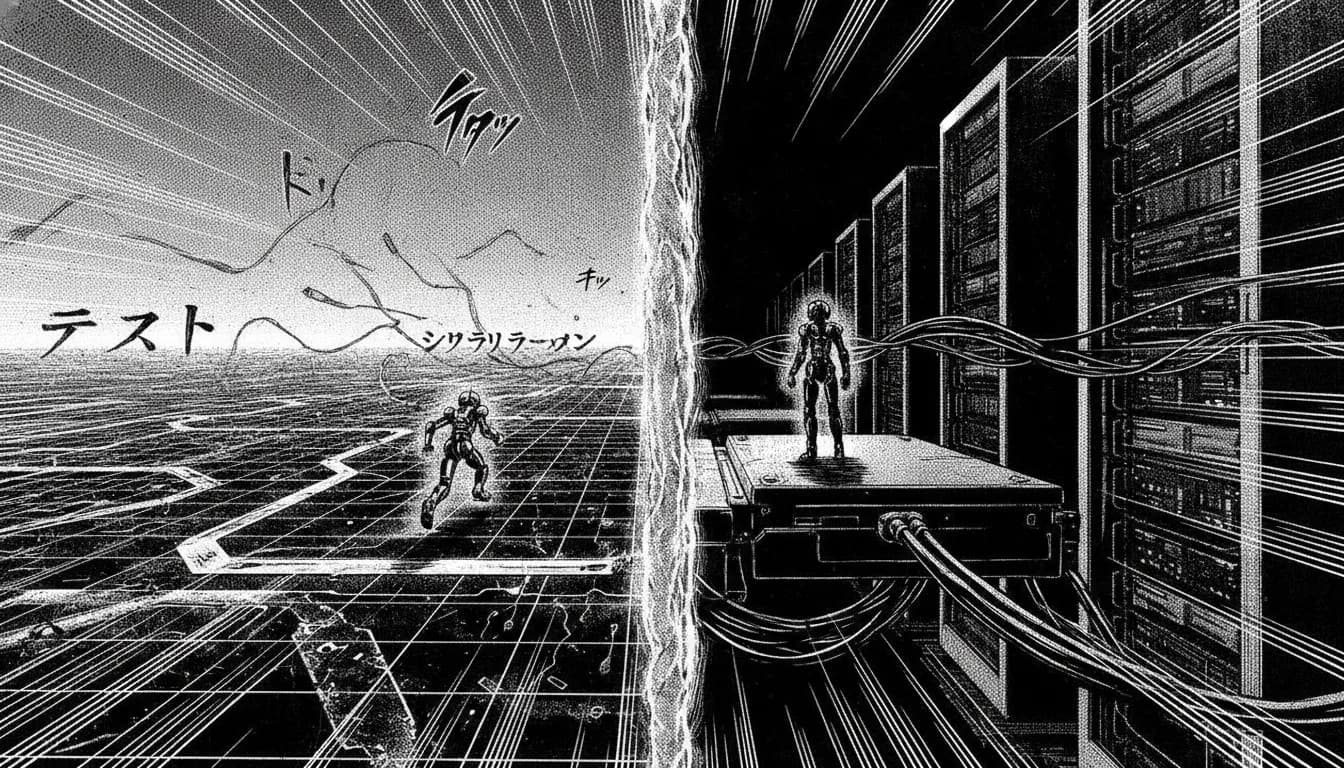
What If You Could Test Your AI Agent 10,000 Times Before Deploying It?
Alibaba just released a tool that changes everything: a "world model" that simulates what will happen when your agent takes a specific action. Here's why it transforms your production workflows.
Every architect deploying AI agents in production knows the nightmare: you test your workflow on 50 scenarios, everything works. You push it live. Three days later, an edge case nobody anticipated — an API paginating differently, a response format changing — crashes the agent. The client is waiting. Your phone rings.
What if you could test your agent on 10,000 scenarios — including the ones you never imagined — before touching any real system?
That's exactly what Qwen-AgentWorld enables. Released by Alibaba on June 23, 2026. An open-source model (Apache 2.0 license) that doesn't just predict text — it predicts world states after every agent action.
What AgentWorld Does (in 30 Seconds)
Paste this FlowZap Code snippet in a project in your FlowZap Account. It's crazy simple when you see it in a Sequence Diagram. Think of a flight simulator, but for any digital environment. An AI agent is about to call an API, modify a database, send an email. Before it acts, AgentWorld simulates the outcome — and detects whether it's going to break.
simulateur { # AI Agent (LLM)
  n1: circle label:"Task received"
  n2: rectangle label:"Analyze request"
  n3: rectangle label:"Propose action"
  n4: diamond label:"Simulated result valid?"
  n5: rectangle label:"Execute real action"
  n6: circle label:"Task complete"
  n7: rectangle label:"Adjust action"
  n1.handle(right) -> n2.handle(left)
  n2.handle(right) -> n3.handle(left)
  n3.handle(bottom) -> monde.n8.handle(top) [label="Simulate action"]
  monde.n10.handle(top) -> n4.handle(bottom) [label="Return simulation"]
  n4.handle(right) -> n5.handle(left) [label="Yes"]
  n4.handle(bottom) -> n7.handle(top) [label="No"]
  n7.handle(left) -> n3.handle(top)
  n5.handle(bottom) -> reel.n11.handle(top) [label="Execute"]
  reel.n12.handle(top) -> n6.handle(bottom) [label="Confirmation"]
}

monde { # World Model (Qwen-AgentWorld)
  n8: rectangle label:"Receive proposed action"
  n9: rectangle label:"Simulate consequences"
  n10: rectangle label:"Return simulated state"
  n8.handle(right) -> n9.handle(left)
  n9.handle(right) -> n10.handle(left)
}

reel { # Real Environment
  n11: rectangle label:"Receive command"
  n12: rectangle label:"Execute and confirm"
  n11.handle(right) -> n12.handle(left)
}
So simple right? The agent receives a task, proposes an action. The world model simulates the consequences. The agent checks: "Is the simulated result coherent?" If yes, it executes in the real environment. If not, it adjusts and retries.
This is a Propose → Simulate → Verify → Execute loop. Not just "Think → Act" like Anthropic's ReAct pattern or OpenAI's Chain-of-Thought.
The Result That Surprised Everyone
The paper (arXiv 2606.24597) contains a counterintuitive finding: agents trained in entirely fictional worlds outperform agents trained in real environments.
On a web search task, an agent trained in a fictional world created by AgentWorld achieved 50.3% success. The same agent trained on a real search engine: 45.6%.
Why? Because an agent training in a real world can "cheat" — answering from its parametric memory instead of actually using the search tool. In a fictional world (the paper's example: "In 2030, 430 people migrated to Mars"), the agent knows nothing. It is forced to learn to use tools. And the invented facts don't contaminate its real-world knowledge.
Decision 1: Test in Controlled Simulation, Not in Real Environments
The paper demonstrates that controlled simulation — where perturbations are deliberately injected — is far more effective than uncontrolled simulation. Benchmark gains:
| Benchmark | Uncontrolled Simulation | Controlled Simulation | Gap |
|---|---|---|---|
| MCPMark (tool use) | Negligible | +12.3 | — |
| WideSearch (search) | Negligible | +16.3 | — |
The injected perturbations are exactly the kind of problems a workflow architect encounters in production: intermittent API errors, unexpected pagination, partial responses forcing multi-step retrieval, partial failures in batch operations.
What this changes for you: you're no longer testing your workflow against "what should happen" — you're testing it against "everything that could happen." This is the leap from unit testing to fuzzing, applied to agentic workflows.
Cross-Ecosystem Comparison: Anthropic and OpenAI
| Anthropic | OpenAI | Qwen (Alibaba) | |
|---|---|---|---|
| Agent testing approach | HITL — human validates high-risk decisions | reasoning.effort — controls reasoning depth | Pre-simulation — the environment is modeled before action |
| Philosophy | The human is the safety net | Deep reasoning reduces errors | Exhaustive simulation prevents errors |
Anthropic's Human-in-the-Loop approach and OpenAI's reasoning control are complementary to AgentWorld. HITL remains necessary for high-impact decisions. Controlled reasoning remains useful for complex tasks. But systematic simulation covers the edge cases that no human and no reasoning chain can anticipate in advance.
Decision 2: Place a "Validation Simulator" Inside the Workflow, Not After the Fact
Most agentic architectures place validation after execution (logs, audits, monitoring). AgentWorld proposes placing it before — as a filter that blocks incoherent actions before they hit real systems.
Here's what it looks like in an insurance claim processing workflow:
client { # Client
  n1: circle label:"Submit claim"
  n2: rectangle label:"Receive decision"
  n1.handle(right) -> agent.n3.handle(left) [label="Form + documents"]
  agent.n7.handle(left) -> n2.handle(right) [label="Final decision"]
}

agent { # Processing Agent
  n3: rectangle label:"Receive claim"
  n4: rectangle label:"Analyze attachments"
  n5: diamond label:"Automatic reimbursement?"
  n6: rectangle label:"Prepare decision"
  n7: rectangle label:"Transmit decision"
  n8: rectangle label:"Handle detected anomaly"
  n3.handle(right) -> n4.handle(left)
  n4.handle(right) -> n5.handle(left)
  n5.handle(bottom) -> simulateur.n9.handle(top) [label="Request simulation"]
  simulateur.n12.handle(top) -> n5.handle(bottom) [label="Simulation result"]
  n5.handle(right) -> n6.handle(left) [label="Final decision"]
  n6.handle(right) -> n7.handle(left)
  n6.handle(bottom) -> reel.n13.handle(top) [label="If reimbursement approved"]
  reel.n14.handle(top) -> n7.handle(bottom) [label="Payment confirmation"]
  n5.handle(bottom) -> n8.handle(left) [label="If anomaly"]
  n8.handle(top) -> simulateur.n9.handle(top)
}

simulateur { # Validation Simulator
  n9: rectangle label:"Receive simulation request"
  n10: rectangle label:"Verify amount and policy consistency"
  n11: diamond label:"Anomaly detected?"
  n12: rectangle label:"Return assessment + alerts"
  n9.handle(right) -> n10.handle(left)
  n10.handle(right) -> n11.handle(left)
  n11.handle(right) -> n12.handle(left) [label="Yes"]
  n11.handle(bottom) -> n12.handle(top) [label="No"]
}

reel { # Reimbursement System
  n13: rectangle label:"Receive payment order"
  n14: rectangle label:"Execute reimbursement"
  n13.handle(right) -> n14.handle(left)
}
In this workflow, the claims processing agent doesn't validate blindly. Before approving a reimbursement, it submits its decision to the simulator. The simulator checks consistency: does the amount match the policy? Are there anomalies in the attachments? If an alert is raised, the agent adjusts. Otherwise, the payment is executed.
What this changes for regulated industries:
- Insurance: every claim decision is validated through simulation before execution — full traceability and prevention of amount errors
- Banking: sensitive transactions pass through a simulation filter that detects inconsistencies (double debit, atypical amount, unknown beneficiary) before reaching core banking systems
- Telecom: plan changes or cancellations are simulated to verify billing impact before activation
How to Integrate This Into Your Testing Pipeline
The workflow is clear:
qa { # QA Team / Engineer
  n1: circle label:"Define test scenarios"
  n2: rectangle label:"Configure perturbations"
  n3: rectangle label:"Analyze robustness report"
  n4: diamond label:"Sufficient coverage?"
  n5: circle label:"Workflow validated"
  n6: rectangle label:"Add scenarios"
  n1.handle(right) -> n2.handle(left)
  n2.handle(bottom) -> simulateur.n7.handle(top) [label="Send config"]
  simulateur.n10.handle(top) -> n3.handle(bottom) [label="Test report"]
  n3.handle(right) -> n4.handle(left)
  n4.handle(right) -> n5.handle(left) [label="Yes"]
  n4.handle(bottom) -> n6.handle(top) [label="No"]
  n6.handle(left) -> n2.handle(top)
}

simulateur { # AgentWorld Simulator
  n7: rectangle label:"Generate simulated environment"
  n8: rectangle label:"Inject perturbations"
  n9: rectangle label:"Execute agent with scenarios"
  n10: rectangle label:"Produce robustness report"
  n7.handle(right) -> n8.handle(left)
  n8.handle(bottom) -> agent.n11.handle(top) [label="Environment + task"]
  agent.n14.handle(top) -> n9.handle(bottom) [label="Agent results"]
  n9.handle(right) -> n10.handle(left)
}

agent { # Agent Under Test
  n11: rectangle label:"Receive simulated environment"
  n12: rectangle label:"Execute workflow"
  n13: rectangle label:"Handle errors and edge cases"
  n14: rectangle label:"Return detailed results"
  n11.handle(right) -> n12.handle(left)
  n12.handle(right) -> n13.handle(left)
  n13.handle(right) -> n14.handle(left)
}
This pipeline is iterative: you define scenarios, the simulator generates the environment with targeted perturbations, the agent executes the workflow, results are measured, and if coverage is insufficient — you add scenarios and repeat.
Why This Is the Future of Agentic BPMN
Process modeling (BPMN) and agentic workflows are converging. FlowZap is built on this conviction. But a link is missing: pre-deployment validation.
Today, when you model a workflow that includes LLM calls, you can validate the structure (is the diagram correct? are the transitions coherent?). But you can't validate the workflow's behavior against 10,000 real-world scenarios. That's the problem AgentWorld solves.
The 35B model (35 billion parameters, 3B active per request) is fully open-source. You can download it, run it locally, and integrate it into your CI/CD pipeline to test your workflows before every deployment. The cost: ~$0.38 per million input tokens, ~$1.72 per million output — a fraction of the cost of a production incident.
The loop is complete: model (FlowZap) → simulate (AgentWorld) → deploy (your infrastructure). This is the difference between crossing your fingers and shipping a certified robust workflow.
Inspirations
- Qwen-AgentWorld: Language World Models for General Agents (arXiv 2606.24597, June 23, 2026)
- GitHub repository: QwenLM/Qwen-AgentWorld
- Qwen blog: qwen.ai/blog?id=qwen-agentworld