
The Wake-Up Call
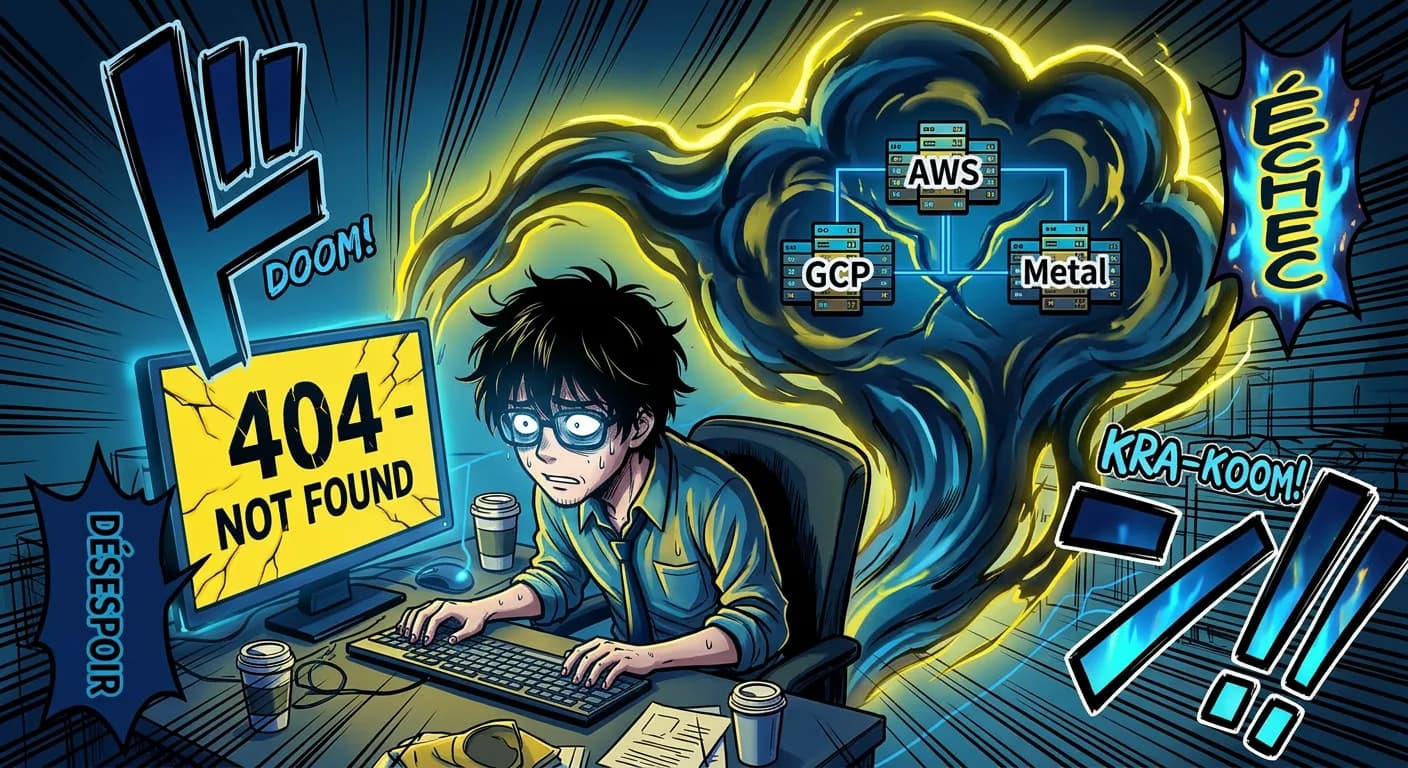
On May 19, 2026 at 22:20 UTC, Railway — a developer platform hosting thousands of production workloads — went completely dark. For eight hours, every customer app returned 404 errors. Deployments froze. Logins broke. Builds stopped.
The cause? Google Cloud incorrectly suspended Railway's production account. An automated action. No warning. No appeal window. Just: account disabled, infrastructure offline, platform dead.
Railway had done the responsible thing. They ran workloads across three environments: Google Cloud, AWS, and their own bare metal. On paper, this was multi-cloud. In practice, it was a single point of failure dressed up as redundancy.
"We take full responsibility for the architectural decisions that allowed a single upstream provider action to cascade into a platform-wide outage." — Railway Postmortem
Here's what actually broke — and what you need to build instead.
How the Cascade Worked
Railway's edge proxies are the front door. Every request hits a proxy, which looks up a routing table to know where the workload lives. That routing table comes from a control plane hosted entirely on Google Cloud.
When GCP suspended the account, the control plane went offline. The proxies kept working for about 15 minutes using cached routes. Then the caches expired. Every proxy lost its map. Workloads on AWS and Railway Metal — physically healthy the entire time — started returning 404 errors because there was no route to reach them.
Then GitHub rate-limited Railway's OAuth endpoints from the retry storm, blocking logins and builds on top of everything else.
The architecture that failed:
Outage Cascade Diagram: (Copy-paste the following FlowZap Code snippet in a Project in your FlowZap Account to view the diagram.)
outage { # GCP Suspension -> Full Outage Cascade
  n1: circle label="GCP suspends account (22:20 UTC)"
  n2: rectangle label="Control plane offline"
  n3: rectangle label="Dashboard / API down"
  n4: rectangle label="Route caches expire (~15 min)"
  n5: rectangle label="Metal workloads -> 404"
  n6: rectangle label="AWS workloads -> 404"
  n7: rectangle label="GitHub OAuth rate-limited"
  n8: circle label="~8 hr platform outage"
  n1.handle(right) -> n2.handle(left)
  n2.handle(top) -> n4.handle(top) [label="immediate"]
  n2.handle(right) -> n3.handle(left) [label="immediate"]
  n4.handle(top) -> n6.handle(top) [label="cache expiry"]
  n4.handle(right) -> n5.handle(left) [label="cache expiry"]
  n3.handle(top) -> n7.handle(top) [label="retry burst"]
  n5.handle(bottom) -> n8.handle(bottom)
  n7.handle(right) -> n8.handle(left)
  n5.handle(top) -> n8.handle(top)
}
The lesson is brutal and simple: distributing where your workloads run is not the same as distributing how traffic reaches them. Multi-cloud compute without a multi-cloud control plane is theater.
The Architecture Root Cause
As Chinese developer @SaitoWu analyzed on X:
"数据面/路由发现仍然有GCP热路径依赖,导致单个云厂商动作级联成全平台outage。"
"The data plane and route discovery still had a GCP hot-path dependency. A single vendor action cascaded into a full platform outage."
That's the thing people miss. Railway had:
- Multi-cloud compute (GCP, AWS, Metal)
- Multi-cloud storage (persistent disks across providers)
- Single-cloud control plane (routing, service discovery, API — all on GCP)
The control plane is the brain. If the brain lives in one cloud and that cloud pulls the plug, the body dies — even if the limbs are spread across three data centers.
The Fix: Multi-Cloud Mesh Architecture
Railway's postmortem outlines three architectural changes:
- Mesh control plane — Route discovery distributed across AWS, GCP, and Metal. Each edge proxy queries multiple control plane nodes. If one cloud disappears, the mesh routes around it.
- Cross-cloud database quorum — High-availability database shards spread across all three providers. If GCP vanishes, the quorum still has a majority on AWS and Metal. Automatic failover with no data loss.
- Remove GCP from the hot path — GCP becomes a secondary/failover option, not a dependency for core routing or service discovery.
Here's what the resilient architecture looks like:
Resilient Architecture: (Copy-paste the following FlowZap Code snippet in a Project in your FlowZap Account to view the diagram.)
resilient { # Multi-Cloud Mesh Architecture
  n1: rectangle label="Traffic -> Any Edge Proxy"
  n2: rectangle label="Mesh Control Plane (AWS/GCP/Metal)"
  n3: rectangle label="Route Discovery — No Single Cloud Dep"
  n4: rectangle label="DB Quorum (AWS)"
  n5: rectangle label="DB Quorum (GCP)"
  n6: rectangle label="DB Quorum (Metal)"
  n7: rectangle label="Compute (AWS)"
  n8: rectangle label="Compute (GCP)"
  n9: rectangle label="Compute (Metal)"
  n1.handle(right) -> n2.handle(left)
  n2.handle(right) -> n3.handle(left)
  n4.handle(right) -> n7.handle(left)
  n3.handle(right) -> n4.handle(left)
  n3.handle(top) -> n5.handle(top)
  n3.handle(bottom) -> n6.handle(bottom)
  n6.handle(top) -> n9.handle(top)
  n5.handle(top) -> n8.handle(top)
}
Implementation Guide: 5 Patterns for Multi-Cloud Resilience
Pattern 1: Control Plane Independence
The rule: Your routing and service discovery must not depend on any single cloud provider.
How to implement:
- Run at least 3 control plane nodes across at least 2 providers
- Use a gossip protocol (Serf, Consul, etc.) for node discovery — no cloud-specific APIs
- Edge proxies query ALL control plane nodes, accept first healthy response
- Cache routes locally with configurable TTL (long enough to survive control plane restart, short enough to pick up changes)
Pitfall to avoid: Don't use a cloud load balancer as the control plane endpoint. If GCP's load balancer is the entry point for your "multi-cloud" control plane, you've just moved the single point of failure from compute to networking.
Pattern 2: Database Quorum Across Clouds
The rule: Your database must survive any single cloud disappearing without data loss.
How to implement:
- Minimum 3 database instances across 3 providers (or 2 providers + 1 on-prem)
- Use Raft or Paxos for leader election — quorum requires N/2+1 nodes
- Configure synchronous replication between quorum members
- Test failover monthly: kill one cloud's DB and verify the quorum elects a new leader within 30 seconds
What Railway learned: They had HA database shards within GCP. When GCP went dark, all shards went dark simultaneously. Within-cloud HA is not cross-cloud HA.
Pattern 3: Routing Table Decoupling
The rule: Edge proxies must be able to populate routing tables without any single cloud API.
How to implement:
- Store routing state in the distributed database quorum (Pattern 2), not a cloud-specific service
- Use a sidecar agent on each proxy that watches the quorum for routing changes
- If the quorum is unreachable, proxies continue serving from local cache
- Never let route cache TTL be shorter than your incident response time
Test scenario: Cut network access to one cloud provider. Verify that proxies continue serving traffic from cache and that new deployments to surviving clouds update routes within the cache window.
Pattern 4: Independent Edge Proxies
The rule: Each cloud's edge proxy must operate independently of the others.
How to implement:
- Deploy at least one edge proxy per cloud provider
- Use Anycast or DNS-based load balancing across all edge proxies
- Health checks must detect proxy failure and remove from rotation within 60 seconds
- Each proxy maintains its own route cache and control plane connections
Pitfall to avoid: Don't use a single cloud's DNS service (Route 53, Cloud DNS) as your only DNS provider. AWS US-EAST-1 went down in October 2025 and took half the internet with it.
Pattern 5: Continuous Cross-Cloud Failure Testing
The rule: If you haven't tested it, it doesn't work.
How to implement:
- Monthly chaos engineering: kill one cloud provider's connectivity and measure recovery
- Automate the test: Terraform/Pulumi to block network ACLs, then verify route failover
- Measure: time to detection, time to route convergence, time to full recovery
- Keep a runbook updated with the last test date and actual recovery times
Railway's lesson: "Documentation and drills paid off." Their runbook got them back online. But the architecture forced an 8-hour recovery. The goal is architecture that makes recovery measured in minutes, not hours.
Deployment Pipeline
Here's what a cross-cloud deployment pipeline looks like:
Deployment Pipeline: (Copy-paste the following FlowZap Code snippet in a Project in your FlowZap Account to view the diagram.)
pipeline { # Cross-Cloud Failover Deployment
n1: circle label="Push to Git"
n2: rectangle label="CI builds container"
n3: rectangle label="Push image to cross-cloud registry"
n4: rectangle label="Health check all endpoints"
n5: diamond label="All healthy?"
n6: rectangle label="Update mesh routing table"
n7: circle label="Live — Multi-Cloud Active"
n1.handle(right) -> n2.handle(left)
n2.handle(right) -> n3.handle(left)
n3.handle(bottom) -> aws.n9.handle(top)
n3.handle(bottom) -> gcp.n10.handle(top)
n3.handle(bottom) -> metal.n11.handle(top)
aws.n9.handle(bottom) -> n4.handle(top)
gcp.n10.handle(bottom) -> n4.handle(top)
metal.n11.handle(bottom) -> n4.handle(top)
n4.handle(right) -> n5.handle(left)
n5.handle(right) -> n6.handle(left) [label="Yes"]
n5.handle(bottom) -> rollback.n8.handle(top) [label="No"]
n6.handle(right) -> n7.handle(left)
}

aws { # AWS
n9: rectangle label="Deploy to AWS (primary)"
}

gcp { # GCP
n10: rectangle label="Deploy to GCP (secondary)"
}

metal { # Metal
n11: rectangle label="Deploy to Metal (tertiary)"
}

rollback { # Rollback
n8: rectangle label="Alert + rollback failed cloud"
n8.handle(right) -> pipeline.n4.handle(bottom) [label="retry"]
}
Chinese Market Implications
This incident has particular resonance in the Chinese tech ecosystem. Several factors make multi-cloud resilience especially relevant:
GCP is widely used in China-adjacent markets. Hong Kong, Singapore, and cross-border SaaS companies rely on GCP for global reach. The Railway outage shows that even "global" cloud providers can be single points of failure.
Chinese cloud providers (Alibaba Cloud, Tencent Cloud, Huawei Cloud) operate in a different regulatory environment. A SaaS company serving both Chinese and Western markets cannot simply "pick one cloud." Data sovereignty laws (PIPL, CSL, DSL) often require data to stay within Chinese borders while business logic runs globally. Multi-cloud is not optional — it's compliance.
@SaitoWu's analysis went viral in Chinese developer circles. The Chinese tech community recognized the pattern immediately: "热路径依赖" (hot-path dependency) is a universal architecture smell, whether you're on GCP, AWS, or Alibaba Cloud.
Key takeaway for cross-border SaaS: If you serve both CN and global users, your architecture must treat cloud providers as interchangeable — not just for resilience, but for legal compliance. A single-cloud architecture that's legal in the US may be illegal in China, and vice versa.
Solopreneur Angle: Selling Multi-Cloud Resilience
Multi-cloud architecture sounds like enterprise infrastructure — the kind of thing that takes Coca-Cola years and a team of 50 engineers. But the solopreneur angle is real and under-exploited.
The play: Deploy client SaaS across AWS + GCP + Azure with multi-cloud failover. Charge premium: "Your SaaS, guaranteed 99.99% uptime across 3 clouds."
Why this works:
- Small SaaS companies cannot afford to build this themselves. The engineering cost is too high relative to their MRR.
- But the value is enormous. Eight hours of downtime kills trust. Customers leave.
- A solopreneur who builds the multi-cloud deployment pipeline once can white-label it for 5+ clients.
The stack:
- Terraform/Pulumi for cross-cloud IaC — one config, three providers
- Kubernetes for workload portability — same containers, any cloud
- CockroachDB or YugabyteDB for cross-cloud database quorum — survives any single cloud failure
- Consul or custom mesh for control plane independence
- Grafana + Prometheus for unified monitoring across all clouds
Revenue model:
- Base: $2,000/mo per client — managed multi-cloud deployment
- Premium: $5,000/mo — includes quarterly chaos engineering tests with reports
- Enterprise: $15,000/mo — compliance documentation, SOC2 audit support, 24/7 on-call
The pitch: "Your SaaS runs on one cloud. If that cloud has a bad day — and they all do — you're down for hours. I deploy your app across three clouds. If one fails, your users never notice."
Inspirations
- Railway Postmortem: Incident Report: May 19, 2026 – GCP Account Suspension
- The Register: Google Cloud suspended major customer Railway.com without cause
- WebHosting.Today: Railway Offline Eight Hours After GCP Error
- Chinese analysis: @SaitoWu on X — Architecture root cause analysis
- Alex Khaerov: Building Resilient Multi-Cloud Architectures in 2026
- Databahn: Dark Clouds: Why Enterprises Are Re-Evaluating Multi-Cloud Architecture
- Huxiu (虎嗅): Google ecosystem disruption coverage
- Hacker News discussion: Railway GCP Postmortem — 550+424 pts