
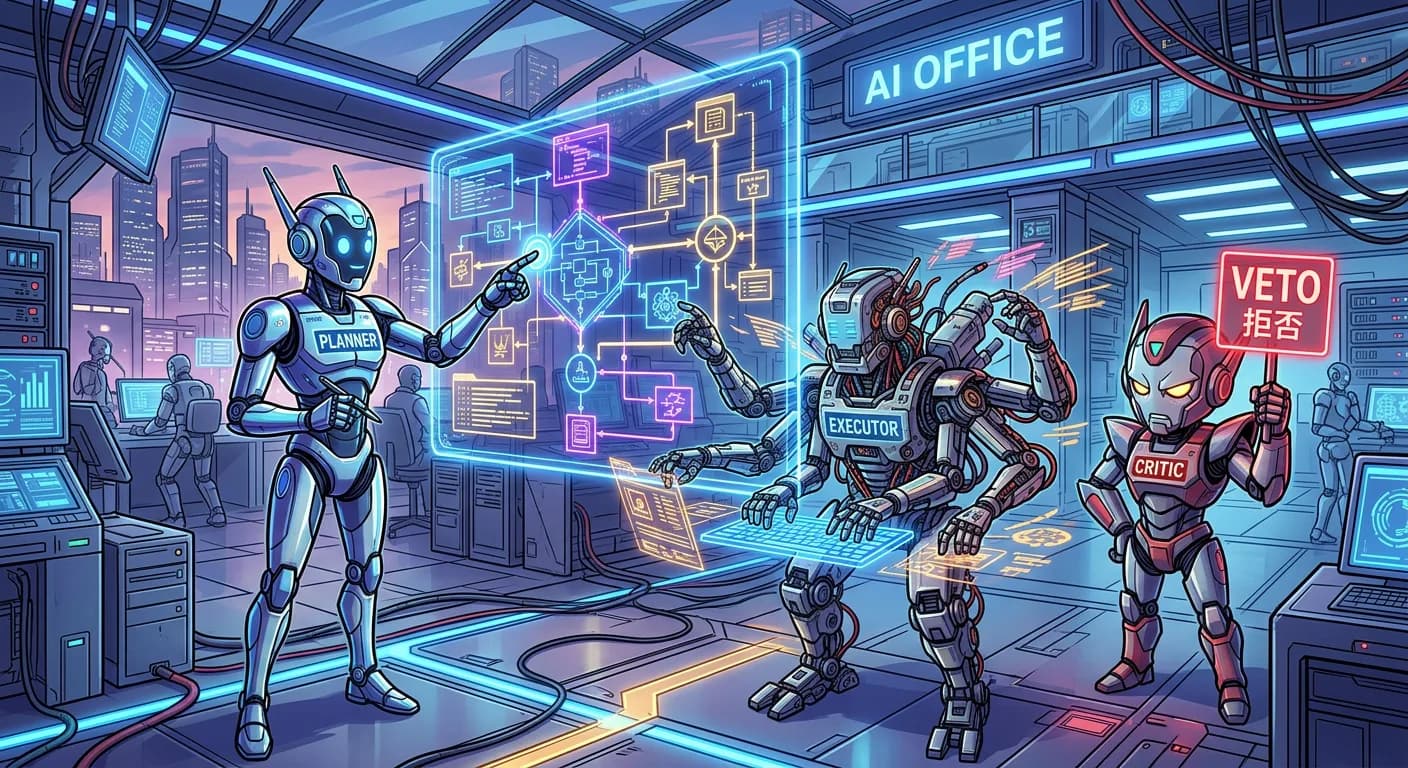
If your AI agent is working alone, you're already falling behind.
Single AI agents are impressive. They can browse the web, write code, summarize documents, and call APIs — all without you lifting a finger. But for anything that actually matters — a business decision, a complex report, a multi-step workflow with real consequences — a single agent will fail you. It runs out of context. It hallucinates. It has no one to check its work.
The shift that separates early adopters from actual winners in 2026 is not "which AI model are you using." It's "how are your agents organized." This is the year of multi-agent systems. And just like a business function outperforms a single freelancer, an AI agent team outperforms a lone agent — reliably, measurably, and at scale.
This article breaks down the five core AI agent team models, explains the architectural principles behind them, and shows you how to template each one in FlowZap so you can go from theory to workflow immediately.
Why Single Agents Hit a Wall
Before getting into team models, it's worth understanding exactly why single-agent systems fail — and why the failure mode matters.
A single general-purpose agent faces three compounding problems:
Context contamination. Every tool result, web scrape, and API response gets dumped into the context window. At scale, this creates noise, reduces coherence, and increases the probability of the model fixating on irrelevant data. There is no separation between what the agent thinks and what the agent has seen.
No adversarial check. A single agent has no internal critic. It produces an answer and moves on. There is no mechanism for catching errors before they reach the user. Systemic biases propagate unchecked. Inner monologues are never written down. Mistakes are not caught — they are delivered.
Context overflow and reliability degradation. Complex workflows require more steps than a single agent can reliably reason across. The agent either makes mistakes mid-chain or exhausts its context window entirely. The result is hallucinations dressed up as confident outputs.
A January 2026 paper from Isotopes AI ("If You Want Coherence, Orchestrate a Team of Rivals," arXiv 2601.14351) put a number on this: on complex financial reconciliation tasks, a single-agent baseline achieved a 60% success rate. The same task using a multi-agent team achieved 92.1%. The difference was not a better model. It was careful orchestration of imperfect ones — with opposing incentives, strict role boundaries, and a separation of reasoning from execution.
That is the premise of AI agent team design: you do not need perfect components. You need a well-designed team.
The Business Case: ROI Is Not Theoretical
The ROI numbers on multi-agent deployments are compelling enough to warrant a full section before touching architecture.
According to a 2025 Agentic AI ROI Survey by PagerDuty, 43% of enterprises are allocating over half of their AI budgets to agentic AI, and 62% expect ROI above 100% — with average projected returns of 171%. U.S. enterprises report even higher: 192% ROI on average.
Multi-agent systems deliver 2–4x the ROI of single-agent deployments, with cost reductions of 25–35% within 18 months becoming the new baseline. IBM's research shows multi-agent orchestration slashes workflow handoffs by 45% and boosts decision speed by 3x.
Specific vertical results are striking:
- Financial services: 80% reduction in loan processing costs
- Healthcare: 90% faster literature reviews
- Manufacturing: 312% ROI in 18 months using 156 specialized agents across facilities
- Cross-functional workflows: 40% improvement in efficiency versus manual or RPA-based approaches
One manufacturing implementation coordinated vibration analysis, temperature monitoring, oil quality, and production scheduling agents simultaneously — optimizing across the entire operation rather than sub-optimizing individual processes. No single agent could have done this.
For knowledge workers specifically, enabling AI agents to handle 25% of cognitive work (coordination, exception management, decision-routing) for a team of 50 employees at average cost delivers over $800,000 in recaptured annual value — redirected to strategy, innovation, and relationships that traditional automation cannot touch.
The market reflects this. Agentic AI is growing at a 43.84% CAGR, from $5.25B in 2024 to a projected $199.05B by 2034 — the fastest-growing enterprise technology segment. Gartner expects a third of agentic AI deployments to run multi-agent setups by 2027.
2026 is the year of multi-agent systems. Let's look at how they're built.
The RPEC Framework: The Atomic Building Blocks
Before jumping to full team models, it helps to understand the four core agent roles that appear across virtually every production multi-agent system. Think of these as the atoms — the team models are the molecules.
| Role | Responsibility | Key Capabilities |
|---|---|---|
| Researcher | Information gathering, retrieval, web search | RAG pipelines, search APIs, document parsing, knowledge bases |
| Planner | Goal decomposition, task sequencing, dependency management | Task queues, state tracking, subtask scheduling |
| Executor | Action performance — calls APIs, writes and runs code, transforms data | Tool use, code execution, external system integration |
| Critic | Output review, error flagging, acceptance criteria validation — with veto power | Evaluation rubrics, quality gates, rejection loops |
The Critic role is the most underbuilt in early-stage multi-agent systems and the most important for production-grade reliability. The Team of Rivals architecture (below) is built entirely around giving Critics real authority — not advisory notes, but the power to stop a workflow and send it back.
Most complex real-world systems also include an Expert role: a domain-specialized agent loaded with narrow, deep knowledge (legal codes, financial regulations, medical protocols) that other agents can query when they hit the edge of their competence.
The 5 AI Agent Team Models
1. The Supervisor–Worker Model
What it is: The most widely deployed multi-agent pattern in enterprise settings. One orchestrator agent receives a high-level goal, breaks it into subtasks, delegates each to a specialist worker agent, monitors execution, handles failures, and synthesizes results. The orchestrator does not execute tasks itself — it manages.
Think of it as: A project manager AI overseeing a team of specialist contributors.
Best for: Complex multi-step tasks with quality control requirements; scenarios where dynamic task decomposition is needed; workflows that need graceful failure recovery.
When to avoid it: When you need real-time responsiveness (the supervisor is a bottleneck); when the supervisor's LLM errors would cascade catastrophically.
Key design decisions:
- Keep the orchestrator's context lean — only progress state and aggregated results, never raw tool outputs
- Workers should be stateless; the orchestrator holds all state
- Build explicit failure-handling logic: what happens when a worker returns a bad result?
FlowZap template concept:
orchestrator_agent {# Orchestrator Agent
  n1: rectangle label="Decompose & Manage Subtasks"
  n5: diamond label="All Passed QA?"
  n6: rectangle label="Synthesize Final Result"

  n1.handle(bottom) -> researcher_agent.n2.handle(top) [label="Task: Gather Sources"]
  n1.handle(bottom) -> writer_agent.n3.handle(top) [label="Task: Draft"]
  n1.handle(bottom) -> qa_agent.n4.handle(top) [label="Task: Review"]

  n5.handle(right) -> n6.handle(left) [label="Yes"]
  n5.handle(top) -> writer_agent.n3.handle(top) [label="No (Fix Draft)"]
}

researcher_agent {# Research Agent
  n2: rectangle label="Retrieve Information (Web/RAG)"
  n2.handle(right) -> orchestrator_agent.n1.handle(right) [label="Summary"]
}

writer_agent {# Writer Agent
  n3: rectangle label="Generate Text"
  n3.handle(right) -> orchestrator_agent.n1.handle(right) [label="Draft"]
}

qa_agent {# QA Agent
  n4: rectangle label="Review Output"
  n4.handle(right) -> orchestrator_agent.n5.handle(left) [label="Flags"]
}

loop [retry loop] writer_agent.n3 qa_agent.n4 orchestrator_agent.n5
Real-world example: A Sales Copilot agent orchestrating a lead scoring subagent, a proposal generation subagent, and a CRM update subagent — all coordinated without manual intervention.
2. The Sequential Pipeline Model
What it is: Agents are arranged in a strict sequence. Each agent transforms or enriches the output of the previous one, then passes it forward. There is no central orchestrator — the flow is deterministic.
Think of it as: An assembly line where each station has a specific function and hands work to the next.
Best for: Tasks with clear sequential dependencies and well-defined handoffs — document processing, content production pipelines, compliance workflows, code review chains.
When to avoid it: When tasks have parallel potential (pipelines serialize inherently parallel work); when early-stage failure should not abort downstream steps.
Key design decisions:
- Define exact data schemas passed between each agent — typed handoffs prevent context drift
- Add a validation node between each major stage
- Allow bypass logic: what happens if a stage is skipped or returns null?
FlowZap template concept:
research_agent {# Research Agent
  n1: rectangle label="Summarize Sources (RAG)"
  n1.handle(right) -> outline_agent.n2.handle(left) [label="Raw Sources"]
}

outline_agent {# Outline Agent
  n2: rectangle label="Structure Headings"
  n2.handle(right) -> writer_agent.n3.handle(left) [label="Document Outline"]
}

writer_agent {# Writer Agent
  n3: rectangle label="Draft Full Text"
  n3.handle(right) -> editor_agent.n4.handle(left) [label="First Draft"]
}

editor_agent {# Editor Agent
  n4: rectangle label="Refine Tone & Grammar"
  n4.handle(right) -> seo_agent.n5.handle(left) [label="Refined Text"]
}

seo_agent {# SEO Agent
  n5: rectangle label="Add Keywords & Meta"
}
Real-world example: A legal compliance pipeline where a document is first parsed for entities, then checked against regulatory databases, then flagged for human review, then formatted for filing — each step a specialized agent with a fixed contract.
3. The Swarm Model
What it is: Multiple agents work on the same or related tasks simultaneously, with no central coordinator. Their outputs are then aggregated, voted on, or merged by a dedicated aggregator node. Agents may even compete — the best output wins.
Think of it as: A parallel sprint. You send a team of runners at the same time, and you take the best result — or combine all of them.
Best for: Tasks where parallelism dramatically reduces latency; use cases that benefit from diverse perspectives (multiple research angles, multiple draft variations); situations where the cost of slow sequential processing is high.
When to avoid it: High-stakes outputs where consistency is critical (swarms produce variance by design); compliance or regulatory use cases.
Key design decisions:
- Design an intelligent aggregator: voting, scoring, LLM-as-judge, or domain-specific heuristics
- Decide whether agents share context (cooperative swarm) or are isolated (competitive swarm)
- Monitor cost carefully — N parallel LLM calls at full context is expensive
FlowZap template concept:
dispatcher_agent {# Dispatcher Agent
  n1: rectangle label="Split Goals & Dispatch"
  n1.handle(bottom) -> research_agent_a.n2.handle(top) [label="Explore Angle 1"]
  n1.handle(bottom) -> research_agent_b.n3.handle(top) [label="Explore Angle 2"]
  n1.handle(bottom) -> research_agent_c.n4.handle(top) [label="Explore Angle 3"]
}

research_agent_a {# Research Agent A
  n2: rectangle label="Parallel Search A"
  n2.handle(bottom) -> aggregator_agent.n5.handle(top) [label="Findings A"]
}

research_agent_b {# Research Agent B
  n3: rectangle label="Parallel Search B"
  n3.handle(bottom) -> aggregator_agent.n5.handle(top) [label="Findings B"]
}

research_agent_c {# Research Agent C
  n4: rectangle label="Parallel Search C"
  n4.handle(bottom) -> aggregator_agent.n5.handle(top) [label="Findings C"]
}

aggregator_agent {# Aggregator Agent
  n5: rectangle label="Merge & Deduplicate"
}
Real-world example: A competitive intelligence workflow where four agents simultaneously analyze four different competitors, then an aggregator merges findings into a unified landscape report — in parallel rather than 4x sequentially.
4. The Hierarchical Model
What it is: A multi-level organizational structure. A top-level executive agent manages mid-level team lead agents, who each manage their own pool of specialist workers. Teams within teams. The hierarchy maps to domain separation.
Think of it as: An org chart for AI. The CEO agent does not talk to junior agents directly — it delegates to department heads who delegate downward.
Best for: Enterprise-scale automation with 10+ specialized agents; workflows spanning multiple departments or domains; systems that need to scale without redesigning the top layer.
When to avoid it: Simple workflows where the overhead of multi-level coordination outweighs the benefit; early-stage prototypes.
Key design decisions:
- Each team lead should have its own context — do not share a single context pool
- Define escalation paths: when does a team lead escalate to the executive agent?
- Assign cost governance at each level — lower-tier agents use cheaper models; executive agents use the most capable
FlowZap template concept:
executive_agent {# Executive Agent
  n1: rectangle label="Route Master Goal"
  n1.handle(bottom) -> research_lead_agent.n2.handle(top) [label="Assign Research"]
  n1.handle(bottom) -> content_lead_agent.n5.handle(top) [label="Assign Content"]
}

research_lead_agent {# Research Lead Agent
  n2: rectangle label="Manage Retrieval Team"
  n2.handle(bottom) -> web_search_agent.n3.handle(top) [label="Web Task"]
  n2.handle(bottom) -> db_retrieval_agent.n4.handle(top) [label="DB Task"]
}

web_search_agent {# Web Search Agent
  n3: rectangle label="Live Web Search"
  n3.handle(right) -> research_lead_agent.n2.handle(right) [label="Web Data"]
}

db_retrieval_agent {# DB Retrieval Agent
  n4: rectangle label="Internal Knowledge RAG"
  n4.handle(right) -> research_lead_agent.n2.handle(right) [label="Internal Data"]
}

content_lead_agent {# Content Lead Agent
  n5: rectangle label="Manage Production Team"
  n5.handle(bottom) -> writer_agent.n6.handle(top) [label="Draft Topic"]
}

writer_agent {# Writer Agent
  n6: rectangle label="Draft Document"
  n6.handle(bottom) -> qa_agent.n7.handle(top) [label="Draft Text"]
}

qa_agent {# QA Agent
  n7: rectangle label="Fact Check"
  n7.handle(right) -> content_lead_agent.n5.handle(right) [label="Final Content"]
}
Real-world example: An enterprise knowledge management system where one team handles data ingestion, another handles synthesis, and a third handles distribution — each coordinated by a team lead agent, all overseen by a master orchestrator.
5. The Team of Rivals Model
What it is: The most architecturally sophisticated — and most production-ready — pattern. Agents are assigned not just roles but opposing incentives. A Planner is optimistic about goal completion. A Critic is constitutionally skeptical and holds veto authority. Errors get caught through adversarial pressure rather than trusting a single model's self-assessment.
Coined from a January 2026 peer-reviewed paper (Isotopes AI, arXiv 2601.14351), the core innovation is twofold:
- Strict role boundaries with opposing incentives — agents are designed to disagree productively
- Separation of perception from execution — agents write code that runs remotely; only summaries return to context, preventing raw data from contaminating reasoning
The system achieved over 90% internal error interception before user exposure.
Think of it as: A legal team where the client (Planner) argues for the outcome, the opposing counsel (Critic) argues against it, and the judge (Executor) can only proceed when both sides reach a resolution.
Core principle: "Coherence emerges not from smarter agents, but from structured disagreement."
Best for: High-stakes outputs where errors are costly — financial reconciliation, legal analysis, medical protocols, compliance reporting; any workflow where user-facing mistakes are unacceptable.
When to avoid it: Real-time use cases where the latency cost of critic loops is prohibitive; lightweight tasks where the overhead exceeds the risk.
Key design decisions:
- Critics must have real veto authority — not advisory notes
- Planner must declare explicit acceptance criteria before Executor acts
- Remote execution for all tool calls — summaries only return to agent context
- Design the rejection loop: what exactly does the Critic reject, and what does the Planner receive back?
FlowZap template concept:
planner_agent {# Planner Agent
  n1: rectangle label="Declare Step-by-Step Plan & Acceptance Criteria"
  n1.handle(right) -> executor_agent.n2.handle(left) [label="Task Plan + Criteria"]
}

executor_agent {# Executor Agent
  n2: rectangle label="Execute Remote Code & Tools"
  n2.handle(right) -> critic_agent.n3.handle(left) [label="Execution Summary"]
}

critic_agent {# Critic Agent
  n3: rectangle label="Validate vs Acceptance Criteria"
  n4: diamond label="Passed Gate?"

  n3.handle(bottom) -> n4.handle(top)
  n4.handle(top) -> planner_agent.n1.handle(bottom) [label="Veto (Reject & Explain)"]
}

loop [Rejection Iteration] planner_agent.n1 executor_agent.n2 critic_agent.n3 critic_agent.n4
Real-world example: Complex financial reconciliation — a Planner declares the expected balance outcomes, an Executor queries the ledger via remote code, a Critic validates the math and flags discrepancies before they reach a human. 92.1% tasks resolved correctly without user exposure to errors.
Choosing the Right Team Model: A Decision Matrix
| Model | Parallelism | Fault Tolerance | Coordination Overhead | Best For | Avoid When |
|---|---|---|---|---|---|
| Supervisor–Worker | Medium | High | Medium | Complex multi-step, dynamic decomposition | Real-time requirements |
| Sequential Pipeline | None | Low | Low | Clear dependencies, assembly-line tasks | Tasks with parallel potential |
| Swarm | Very High | Medium | Low–Medium | Research, ideation, parallel generation | Consistency-critical outputs |
| Hierarchical | Medium–High | High | High | Enterprise-scale, multi-domain | Simple workflows, prototypes |
| Team of Rivals | Low–Medium | Very High | High | High-stakes, error-sensitive outputs | Real-time latency constraints |
Framework Landscape: How Leading Tools Map to These Models
If you're building any of these models in code, the framework you choose will shape your implementation significantly.
LangGraph (by LangChain) treats agent workflows as directed acyclic graphs (DAGs) with nodes and edges. Exceptional for the Team of Rivals model (conditional veto loops map naturally to graph nodes), the Sequential Pipeline, and the Hierarchical model. Highest control, steepest learning curve.
CrewAI uses role-based collaboration inspired by human teams. Agents are defined by role, goal, and backstory. The best fit for the Supervisor–Worker model — it makes the organizational metaphor explicit. Fastest time-to-production for team-based setups.
AutoGen (Microsoft) is conversation-driven. Agents collaborate through natural language dialogue. Best for the Swarm model and human-in-the-loop scenarios. Most flexible for rapid prototyping; less formal in structure.
| Framework | Architecture Style | Best Model Fit | Structured Output | Human-in-the-Loop |
|---|---|---|---|---|
| LangGraph | Graph-based (DAGs) | Team of Rivals, Pipeline, Hierarchical | Strong (state-based) | Graph hooks |
| CrewAI | Role-based | Supervisor–Worker | Role-enforced | Task checkpoints |
| AutoGen | Conversational | Swarm, Human-in-loop | Flexible | Conversational proxy |
The choice ultimately depends on how you think about your workflow: as a flowchart (LangGraph), as a team structure (CrewAI), or as a conversation (AutoGen).
The "AI Office" Mental Model
One of the most useful conceptual shifts for business builders — not engineers — is thinking of your multi-agent system not as an API topology, but as an organization.
Your agents have titles. They have reporting lines. They have an inbox, a scope of authority, and a handoff protocol. The Team of Rivals paper formalized this: it described a production system with over 50 specialized agents organized into an "AI Office" — planners, executors, critics, and domain experts — each with a defined role, boundaries, and accountability structure.
Applied to a real business workflow, this looks like:
- Chief of Staff Agent: receives the goal, decomposes and routes
- Research Lead: manages retrieval agents, RAG queries, and summarization
- Content Director: manages writer, editor, and formatter agents
- Quality Director: manages fact-checker, critic, and compliance agents
- Domain Experts: on-call specialists (legal, financial, technical) queried as needed
This framing matters because it makes multi-agent design accessible to non-engineers. If you can draw an org chart, you can sketch a multi-agent architecture. The FlowZap diagram is the org chart.
Common Failure Modes to Avoid
Even well-designed agent teams fail. The most common failure patterns in production:
1. Context contamination at the top. The orchestrator accumulates raw tool outputs from every worker. Context explodes. Quality degrades. Fix: workers return structured summaries only; raw data stays in remote execution.
2. A Critic with no real authority. The Critic can flag, but not stop. Errors pass through anyway. Fix: make rejection a hard gate in the workflow — the Executor cannot proceed until the Critic accepts.
3. Infinite retry loops. The Planner–Critic loop runs without a bounded exit condition. Fix: set a max iterations parameter, and define an escalation path (human-in-the-loop, or graceful failure output).
4. Mismatched context scopes. Agents in different layers of a hierarchy can see each other's private context, causing cross-contamination. Fix: each agent has a scoped context; only the declared interface is shared.
5. Under-specifying acceptance criteria. The Planner declares a goal without declaring what "done" looks like. The Critic has nothing to evaluate against. Fix: force the Planner to write acceptance criteria as a structured object before any Executor action begins.
What This Means for Your Competitive Position
The organizations gaining ground in 2026 are not the ones with the biggest AI budgets. They are the ones that have internalized this shift: the competitive edge is in orchestration design, not model selection.
The model (GPT-4o, Claude 3.7, Gemini 2.0) is a commodity. The team architecture is your proprietary layer. When your Supervisor–Worker system processes a research brief that would take a human team three hours, in four minutes, with a Critic intercepting errors before they reach you — that is a structural advantage that compounds.
Multi-agent systems that deliver 2–4x ROI over single agents are not doing so because they use a better LLM. They are doing so because they have a Researcher that finds more, a Planner that sequences better, an Executor that acts accurately, and a Critic that catches what would otherwise reach your customer.
Start with the model that fits your highest-stakes workflow. Design the roles first, the tools second, the model choice last. And draw your org chart.
Building in FlowZap: Where to Start
If you want to implement any of these models in FlowZap, the recommended progression:
- Start with a 3-node Supervisor–Worker: one orchestrator, two workers, one aggregator. Get comfortable with context scoping and typed handoffs.
- Add a Critic node to any existing workflow: hook it after the last executor step. Give it acceptance criteria and a rejection path. This alone significantly improves output quality.
- Add parallelism once sequential is stable: fork a single step into two parallel workers and add an aggregator. This is your first Swarm.
- Build the Team of Rivals pattern once you understand context management: the Planner–Executor–Critic loop with a remote execution layer is the most powerful and most demanding architecture.
The diagrams in this article are your templates. Each one maps directly to a FlowZap architecture. The topology is the architecture — design it explicitly, and your agents will behave predictably.
Inspiration
- If You Want Coherence, Orchestrate a Team of Rivals (arXiv 2601.14351)
- arXiv 2601.14351v1
- AI Agent Teams in 2026: How Multi-Agent Systems Actually Work
- Multi-Agent Orchestration Patterns
- AI Landscape 2026: Why the Era of Agentic Automation Changes Everything
- Multi-Agent Frameworks
- Multi-Agent Orchestration
- If 2025 Was the Year of AI Agents, 2026 Will Be the Year of Multi-Agent Systems
- Spring AI Agentic Patterns: Task Subagents
- How to Ensure AI Agents Become Strategic Partners
- Multi-Agent AI Collaboration 2026
- Mastering Multi-Agent Orchestration
- AI Agents Take Center Stage
- Designing Multi-Agent Intelligence
- AI Trends Shaping Agentic Commerce
- Agent Roles: Key Takeaways
- Real-World Multi-Agent Examples
- Multi-Agent AI Systems for Enterprise
- How Multi-Agent Systems Work in Business
- Agentic AI Workflows Guide
- AI Agent Examples Shaping Business
- Team of Rivals: AI CrewAI Multi-Agent Systems
- Agentic AI Statistics
- CrewAI vs LangGraph vs AutoGen
- Top 10 Agent Frameworks 2026
- Choosing the Right Orchestration Pattern
- AI Agent Frameworks
- Multi-Agent Orchestrator and Sub-Agent
Multi-agent AI team design is the new infrastructure layer. The builders who internalize these patterns in 2026 will operate at a different speed than those who don't!