
大多数美国 AI 提供商正在悄悄地把价格螺丝越拧越紧。
OpenAI 现在把用户推向 Free、Plus、Pro、Business、Enterprise 这条更细分的阶梯,其中 Pro 定价为每月 200 美元,Business 则按席位收费。
Anthropic 也围绕更高强度的使用扩展了套餐结构,包括 Claude Max 档位和面向全天运行 AI 工作流用户的团队方案。
是的,他们偶尔会退一步,但很快又会找到新的方式从你的信用卡里多拿一点。
对 AI 构建者来说,信号已经很清楚:如果模型正在变成你的操作系统,那么供应商就想收更高的“租金”。
这并不意味着开发者就无能为力。
它意味着“把 prompt 发出去然后看结果”的老思路,正在变得飞快地昂贵起来。
没错,我自己也暂时切到 DeepSeek V4 了,但这真的是长期方案吗?
对于那些仍然不想自托管这些万亿参数 LLM 的人来说,其他中国供应商也并不便宜。
最终会赢的团队,是那些把 token 使用同时视为产品设计、系统设计和工作流设计问题的人。
也正因为如此,token 优化才会成为构建 agent、编码工具、copilot 和内部 AI 系统的工程师们如此重要的话题。
它已经是工作的一部分了。
这篇文章给出五个实用方案。
每个方案都针对一种不同的 token 浪费,而且都非常适合用 FlowZap Code 可视化表达。
Token 浪费通常藏在底层管线里:你选的模型层级、保留的上下文、加载的工具、忽略的缓存、以及你默认接受的冗长输出。
新的 AI 税
这股压力正在两个方向同时发生。
第一,主打套餐正在变得更细分、也更昂贵,尤其是对依赖长上下文窗口、agentic 工具或全天使用的开发者而言。
第二,随着工作流能力越来越强,也更容易在不知不觉间把 token 使用量抬高:重复指令、庞大的工具 schema、过量上下文、以及冗长的模型输出,都会让成本悄悄上涨。
所以真正的问题不仅是:“团队应该选哪家供应商?”
更根本的问题是:团队怎样才能继续构建雄心勃勃的 AI 工作流,而不在每次请求上都被狠狠抽成?
这正是下面五个方案要解决的事。
方案 1:别把每个任务都丢给最贵的模型
最明显的成本漏洞,就是模型选择。
太多产品把最强模型当成所有任务的默认答案,即使任务只是轻量提取、简单分类、格式清理,或者狭窄上下文上的常规问答。
这相当于让一辆豪华轿车去送一份三明治。
路由层可以解决这个问题。
系统不再默认所有工作都交给同一个模型,而是先判断任务、估计难度,再把它路由给“足够好、但更便宜”的模型。
这个设计能把“高配模型无处不在”变成分层系统:小任务走便宜模型,中等任务走中档,只有真正困难的任务才碰昂贵模型。
好消息是,开源生态已经足够成熟,可以直接上手。
RouteLLM 本身就是围绕模型路由和评估构建的。
LiteLLM 则是很多团队已经在用的 gateway 风格方案,让这个思路更像标准生产管线,而不是理论练习。
client { # Application
n1: circle label:"User request"
n10: circle label:"Deliver response"
n1.handle(bottom) -> gateway.n2.handle(top) [label="Query"]
}

gateway { # LLM Gateway
n2: rectangle label:"Extract intent & length"
n3: diamond label:"Requires heavy reasoning?"
n4: rectangle label:"Select Flash / Haiku"
n5: rectangle label:"Select Pro / Opus"
n8: rectangle label:"Normalize response"
n9: rectangle label:"Log token metrics"
n2.handle(right) -> n3.handle(left)
n3.handle(bottom) -> n4.handle(top) [label="No"]
n3.handle(right) -> n5.handle(left) [label="Yes"]
n4.handle(bottom) -> providers.n6.handle(top) [label="Call budget API"]
n5.handle(bottom) -> providers.n7.handle(top) [label="Call premium API"]
n8.handle(right) -> n9.handle(left)
n9.handle(top) -> client.n10.handle(bottom) [label="Final result"]
}

providers { # Model APIs
n6: rectangle label:"Process fast"
n7: rectangle label:"Process deep reasoning"
n6.handle(top) -> gateway.n8.handle(bottom) [label="Return answer"]
n7.handle(top) -> gateway.n8.handle(bottom) [label="Return answer"]
}
大家都能理解:为本来不需要高配处理的工作支付高价,是多么让人心疼。
路由把 token 优化变成了一条很简单的规则:别再为轻活付重价。
方案 2:让上下文先减肥,再交给模型
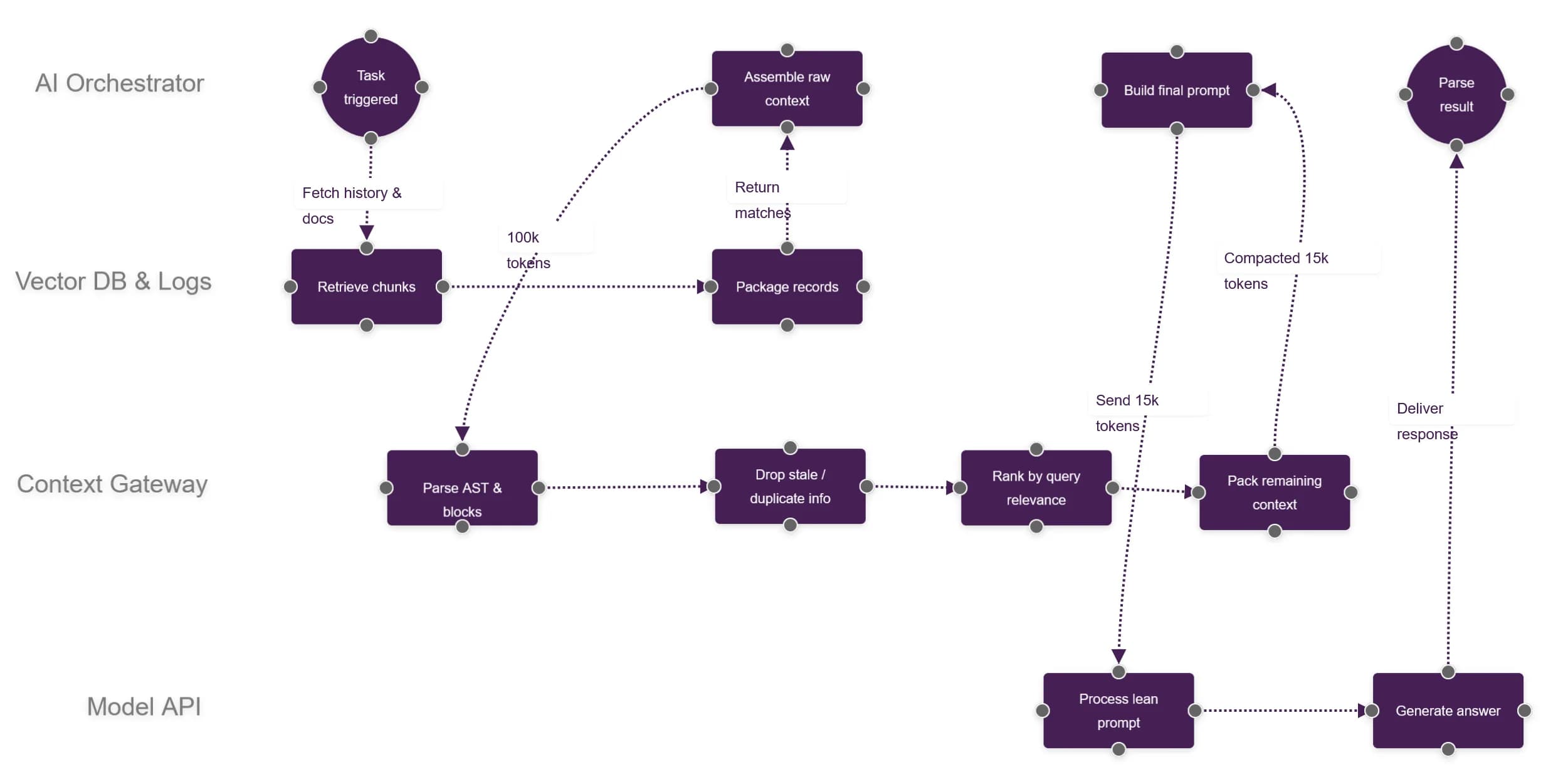
agent 系统里最隐蔽的成本之一,就是“上下文肥胖”。Agent 一开始很小,随后却不断堆积聊天历史、工具日志、文档、检索片段、错误信息,以及前面轮次留下的各种碎片,最后每次请求都像拖着一只行李箱穿过机场。然后团队再疑惑为什么账单看起来不太对劲。
上下文压缩就是解药。重点不是把一切重写成摘要,而是去掉重复内容、过期内容和低价值杂项,同时保留当前步骤真正还需要的信息。Anthropic 的 context engineering 指南也强调:好的 agent 表现依赖于对上下文的有意识选择和塑形,而不是把尽可能多的文本硬塞进窗口。
作为构建者,你不需要“更多上下文”。你需要的是正确的上下文,就像旅行者需要登机箱,而不是搬家卡车。把这件事画成架构步骤后,解决方案就一目了然了:
agent { # AI Orchestrator
n1: circle label:"Task triggered"
n4: rectangle label:"Assemble raw context"
n9: rectangle label:"Build final prompt"
n12: circle label:"Parse result"
n1.handle(bottom) -> datastore.n2.handle(top) [label="Fetch history & docs"]
n4.handle(bottom) -> compactor.n5.handle(top) [label="100k tokens"]
n9.handle(bottom) -> llm.n10.handle(top) [label="Send 15k tokens"]
}

datastore { # Vector DB & Logs
n2: rectangle label:"Retrieve chunks"
n3: rectangle label:"Package records"
n2.handle(right) -> n3.handle(left)
n3.handle(top) -> agent.n4.handle(bottom) [label="Return matches"]
}

compactor { # Context Gateway
n5: rectangle label:"Parse AST & blocks"
n6: rectangle label:"Drop stale / duplicate info"
n7: rectangle label:"Rank by query relevance"
n8: rectangle label:"Pack remaining context"
n5.handle(right) -> n6.handle(left)
n6.handle(right) -> n7.handle(left)
n7.handle(right) -> n8.handle(left)
n8.handle(top) -> agent.n9.handle(bottom) [label="Compacted 15k tokens"]
}

llm { # Model API
n10: rectangle label:"Process lean prompt"
n11: rectangle label:"Generate answer"
n10.handle(right) -> n11.handle(left)
n11.handle(top) -> agent.n12.handle(bottom) [label="Deliver response"]
}
在工具层面,Compresr’s Context Gateway 把压缩当成基础设施层,而不是一次性小修补。LangChain 的 context engineering 资料则更进一步:问题不只是压缩,而是要智能地选择、组织和隔离上下文。
方案 3:让提供商记住那些永远不变的内容
这个方案简单到有点过分。如果 prompt 的前半部分从来不变,为什么每次都要按全价付费?Prompt caching 之所以存在,就是因为稳定前缀在真实系统里很常见:指令、策略、工具列表、静态文档、schema 和 guardrail 往往会在多次调用中重复。
诀窍在于 prompt 结构。很多团队会在前面过早混入变化很大的用户数据,或者每一轮都重建一整大段指令,从而毁掉缓存。更好的设计,是把可复用的前缀保持稳定并前置,然后再追加少量动态内容。这样提供商就能复用缓存工作的结果,只对差异部分计费。
这个机制非常漂亮:第一次和后面 200 次完全不同。第一次调用做重活,后续调用则走快车道。
client { # Application
n1: circle label:"Start Run 1"
n2: rectangle label:"Assemble static system prompt"
n3: rectangle label:"Append volatile user input"
n7: rectangle label:"Receive Answer 1"
n8: circle label:"Start Run 2"
n9: rectangle label:"Reuse static system prompt"
n10: rectangle label:"Append new volatile user input"
n13: rectangle label:"Receive Answer 2"
n14: circle label:"Session done"
n1.handle(right) -> n2.handle(left)
n2.handle(right) -> n3.handle(left)
n3.handle(bottom) -> provider.n4.handle(top) [label="Send 51k tokens"]
n7.handle(right) -> n8.handle(left)
n8.handle(right) -> n9.handle(left)
n9.handle(right) -> n10.handle(left)
n10.handle(bottom) -> provider.n11.handle(top) [label="Send 51k tokens"]
n13.handle(right) -> n14.handle(left)
}

provider { # Model Provider
n4: rectangle label:"Cache Miss: compute full attention"
n5: rectangle label:"Write KV cache for 50k prefix"
n6: rectangle label:"Compute 1k delta & generate"
n11: rectangle label:"Cache Hit: read 50k from KV cache"
n12: rectangle label:"Compute 1k delta & generate"
n4.handle(right) -> n5.handle(left)
n5.handle(right) -> n6.handle(left)
n6.handle(top) -> client.n7.handle(bottom) [label="Cost: $1.00"]
n11.handle(right) -> n12.handle(left)
n12.handle(top) -> client.n13.handle(bottom) [label="Cost: $0.10"]
}
如果你对不断上涨的套餐价格感到烦躁,请记住:你未必需要换工具或换供应商才能降低成本。很多时候,你只需要像个成年人一样组织请求。Prompt caching 一旦画出来,就会变成一种几乎有点“显而易见”的优化。
方案 4:别在每次请求里加载整个工具宇宙
除了基础问题,还有一个真正的内部痛点。随着 agent 开始使用 MCP 服务器和更大的工具目录,团队发现模型卡住的不只是用户输入,还有那些一再重新加载的巨大工具定义、参数 schema、描述和示例。这就是隐藏的 token 税。
这很重要,因为它不只是小小的低效。MCP 生态正在积极讨论正式的减轻 schema 膨胀的方法,包括去重和基于检索的工具选择,因为这个问题大到足以扭曲整个工作流。Speakeasy 的 dynamic toolset 做法也朝同一方向推进:只暴露当前任务真正需要的工具,而不是把整套厨房工具箱都塞进 prompt。
这里的架构对比非常鲜明。一边是系统把所有 schema 都塞进每一次请求,然后惊讶为什么账单会爆掉。另一边则是先判断真正需要什么,只拉取相关工具定义,并保持 prompt 轻量。
agent { # AI Agent
n1: circle label:"New objective"
n2: rectangle label:"Analyze required capabilities"
n5: rectangle label:"Construct prompt with 2 schemas"
n8: circle label:"Execute step"
n1.handle(right) -> n2.handle(left)
n2.handle(bottom) -> registry.n3.handle(top) [label="Request tools by intent"]
n5.handle(bottom) -> llm.n6.handle(top) [label="Send lean request"]
}

registry { # MCP Tool Registry
n3: diamond label:"Match intent to tools"
n4: rectangle label:"Extract specific schemas (not all 50)"
n3.handle(right) -> n4.handle(left)
n4.handle(top) -> agent.n5.handle(bottom) [label="Return 2 schemas"]
}

llm { # Model API
n6: rectangle label:"Process 500 tool tokens (not 10k)"
n7: rectangle label:"Select tool to call"
n6.handle(right) -> n7.handle(left)
n7.handle(top) -> agent.n8.handle(bottom) [label="Return tool call"]
}
很多最大的成本,并不是因为“用了太多 AI”这个抽象问题,而是因为系统结构不佳,而供应商又很乐意按这个价格收钱。
方案 5:先给输出套上缰绳,免得输出反过来套住你
输入 tokens 总是更受关注,但很多产品真正悄悄流血的地方,其实是输出 tokens。模型本来可以只给 JSON,却写出一大段长文。本来只需要一个 patch,却重写了整个文件。本来应用只要一个结果,它却把冗长推理也一股脑吐出来。然后下一步 agent 还得把这些膨胀后的输出再吃进去,于是今天的输出浪费,变成了明天的输入浪费。
解决办法就是输出预算。设置 max_tokens。使用 stop sequence。要求结构化输出。在应用能直接应用的情况下,优先用 diff 和 patch,而不是整文件重写。把 schema 收紧,让模型不那么容易滑进散文模式。这个方法不如“大上下文窗口”那么炫,但它往往才是日常节省最明显的地方。
作为 builder,别人会向你兜售更多上下文、更多 agent 循环、更多自治、更多魔法。很好。但如果你的系统一打喷嚏就回你一篇小作文,那你付的钱其实是在买表演艺术。输出预算,就是团队决定要“有用的答案”,而不是文学装饰的时候。
app { # Orchestrator
n1: circle label:"Task initiated"
n2: rectangle label:"Apply output schema (JSON, Diff)"
n3: rectangle label:"Set max_tokens=500"
n6: diamond label:"Parses correctly?"
n7: rectangle label:"Tighten system prompt"
n8: circle label:"Proceed to next step"
n1.handle(right) -> n2.handle(left)
n2.handle(right) -> n3.handle(left)
n3.handle(bottom) -> provider.n4.handle(top) [label="Strict constraints"]
n6.handle(right) -> n8.handle(left) [label="Yes"]
n6.handle(bottom) -> n7.handle(top) [label="No"]
n7.handle(left) -> n2.handle(bottom) [label="Retry with penalties"]
}

provider { # LLM API
n4: rectangle label:"Process request"
n5: rectangle label:"Generate formatted output"
n4.handle(right) -> n5.handle(left)
n5.handle(top) -> app.n6.handle(bottom) [label="Returns exact shape"]
}
这个方案最大的好处就是立刻能做。你不需要等未来模型发布,也不需要更好的价格档位。你今天就可以决定:输出必须为应用而设计,而不是任由它乱跑。
真正属于这篇文章的 GitHub 工具箱
人很容易迷失在无穷无尽的 GitHub 仓库列表里。所以这里给出一个和这五个方案直接对应的精选工具箱。它们证明了:每一种优化都不是空谈,而是已经有生产级工具在支撑。
| 方案 | 仓库或产品 | 为什么重要 |
|---|---|---|
| 方案 1:路由 | RouteLLM | 专为模型路由与评估而生。 |
| 方案 1:路由 | LiteLLM | 适合路由、fallback 和多供应商场景的强力生产级 gateway 架构。 |
| 方案 2:上下文压缩 | Compresr Context Gateway | 把上下文压缩当作一层专门的基础设施。 |
| 方案 2:上下文压缩 | LangChain context engineering | 提供上下文选择、排序与结构化的框架。 |
| 方案 3:提示缓存 | 供应商原生功能 | 只要把 prompt 结构成“静态前缀优先”,就能立即使用。 |
| 方案 4:schema 减肥 | MCP SEP-1576 | 确认 schema 膨胀是生态中的真实问题,并提出去重标准。 |
| 方案 4:schema 减肥 | Speakeasy dynamic toolsets | 只加载当前任务真正需要的工具,是非常实用的实现方式。 |
| 方案 5:输出预算 | Structured-output 功能 | 大多数 API 都有,但更需要应用层纪律。 |
| 相关优化 | GPTCache | 适合高重复场景中的语义缓存。 |
| 相关优化 | vCache | 当缓存可靠性和误差边界更重要时,适合语义缓存。 |
| 相关优化 | LLMLingua | 在需要压缩 KV cache 时,它是 prompt 压缩的标准工具之一。 |
语义缓存和提示压缩依然重要。但对于今天大多数 AI 构建者来说,更大的问题是:路由、上下文、工具、缓存和输出控制这些环节上的架构浪费。
结论
大型供应商还会继续把用户往更高档位、更大承诺、更昂贵的工作方式上推。这种趋势大概率不会逆转。但你不必把每一项成本都当成不可避免。你可以更好地路由、压缩上下文、利用缓存、减少工具加载,并像专业人士一样管理输出预算。
如果模型供应商想从 AI 构建者身上榨更多钱,那么现在是时候变得更难被压榨了。
灵感来源
- OpenAI Business Pricing: https://openai.com/business/chatgpt-pricing/
- ChatGPT Rate Card: https://help.openai.com/en/articles/11481834-chatgpt-rate-card
- ChatGPT Enterprise Guide: https://www.hungyichen.com/en/insights/chatgpt-enterprise-guide
- Claude 2026 Pricing Guide: https://www.heyuan110.com/posts/ai/2026-04-03-claude-pricing-complete-guide/
- Finout Claude Pricing Breakdown: https://www.finout.io/blog/claude-pricing-in-2026-for-individuals-organizations-and-developers
- AI Coding Tools Pricing: https://ijonis.com/en/ai-coding-tools-pricing
- Anthropic Context Engineering: https://www.anthropic.com/engineering/effective-context-engineering-for-ai-agents
- Redis Token Optimization: https://redis.io/blog/llm-token-optimization-speed-up-apps/
- RouteLLM GitHub: https://github.com/lm-sys/routellm
- RouteLLM Cost Reduction Writeup: https://gaodalie.substack.com/p/routellm-how-i-route-to-the-best
- LiteLLM GitHub: https://github.com/BerriAI/litellm
- LiteLLM Routing Docs: https://github.com/BerriAI/litellm/blob/main/docs/my-website/docs/routing.md
- Claude Automatic Context Compaction: https://platform.claude.com/cookbook/tool-use-automatic-context-compaction
- Compresr Context Gateway: https://compresr.ai/gateway
- Compresr Architecture Writeup: https://lilting.ch/en/articles/compresr-context-gateway-agent-proxy
- LangChain Context Engineering Repo: https://github.com/langchain-ai/context_engineering
- SylphAI Prompt Caching Guide: https://sylphai.substack.com/p/the-complete-guide-to-prompt-caching
- Prompt Caching Infrastructure Guide: https://introl.com/blog/prompt-caching-infrastructure-llm-cost-latency-reduction-guide-2025
- ProjectDiscovery Cost Cut Writeup: https://projectdiscovery.io/blog/how-we-cut-llm-cost-with-prompt-caching
- MCP SEP-1576 (Schema Bloat Proposal): https://github.com/modelcontextprotocol/modelcontextprotocol/issues/1576
- Speakeasy Dynamic Toolsets: https://www.speakeasy.com/blog/how-we-reduced-token-usage-by-100x-dynamic-toolsets-v2
- Chrome DevTools MCP Token Issue: https://github.com/ChromeDevTools/chrome-devtools-mcp/issues/340
- Token-Budget-Aware Reasoning: https://gist.github.com/thehunmonkgroup/aceb859a819729711bdb815cc946a34c
- Simbian Structured Outputs: https://simbian.ai/blog/using-structured-outputs-to-chain-llm-pipelines
- Google ADK Output Limits Issue: https://github.com/google/adk-python/issues/701
- GPTCache GitHub: https://github.com/zilliztech/gptcache
- GPTCache Overview: https://zilliz.com/what-is-gptcache
- vCache GitHub: https://github.com/vcache-project/vCache
- LLMLingua GitHub: https://github.com/microsoft/llmlingua
- LLMLingua Integration: https://microsoft.github.io/promptflow/integrations/tools/llmlingua-prompt-compression-tool.html